



My name is Mir Abdullah Miri. I am an Afghan refugee scholar and lecturer in education. I first came to refugee support because I needed it. Today, I contribute as an education adviser, community adviser and volunteer. Knowing support from both positions has left me with a question I cannot answer easily. When we call a refugee courageous, are we recognising what they have endured, or overlooking what they still need?
I did not want to answer those questions alone. I invited Afghans living in the diaspora to complete four unfinished sentences. ‘Courage sounds like…’, ‘Courage looks like…’, ‘Courage feels like…’ and ‘Courage needs…’. The invitation was anonymous, and people could respond in any language with one word or a short phrase. Fifty-three people took part, and their words became A Collective Mosaic of Courage.
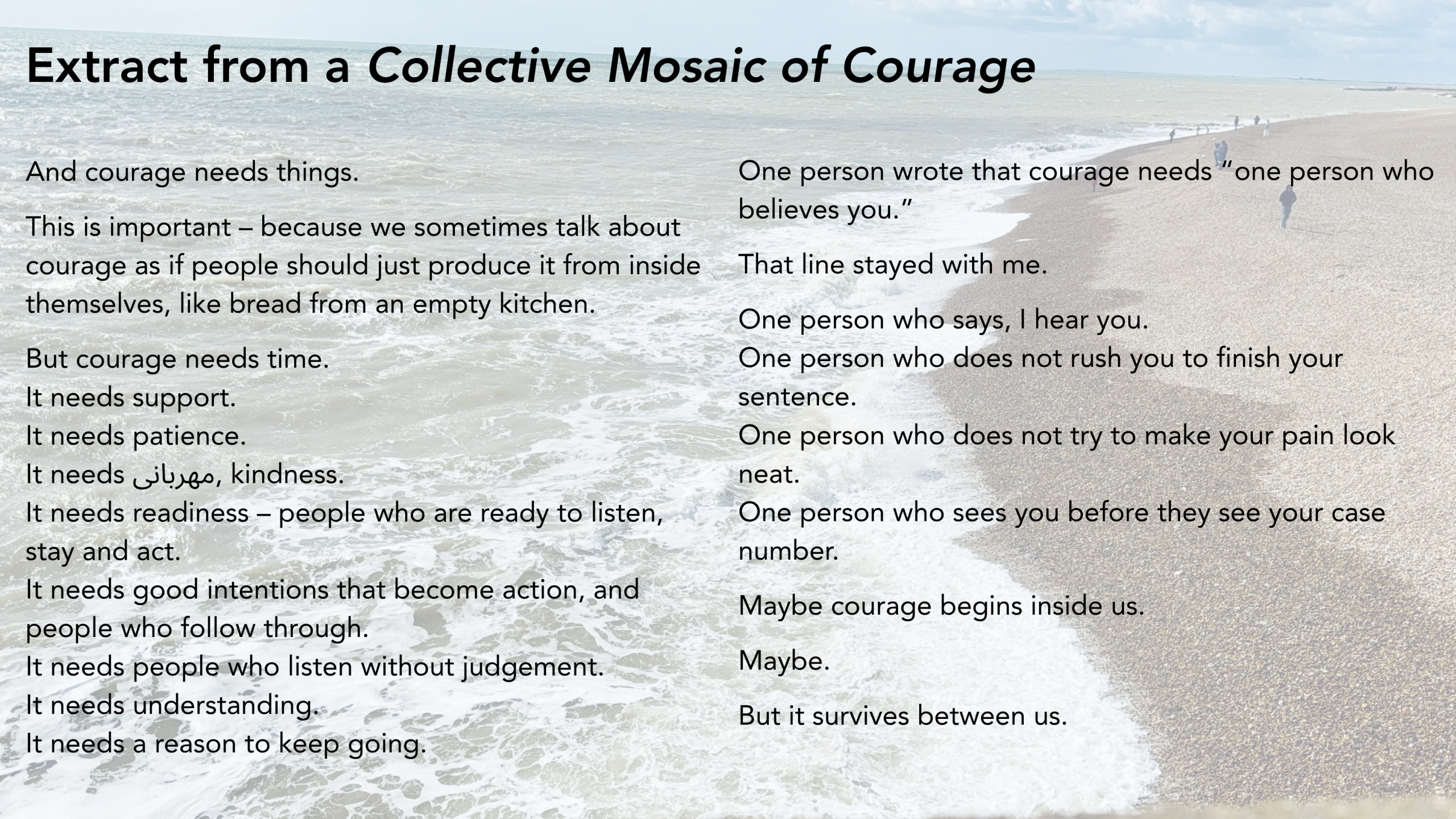
When the responses arrived, I read each one more than once – some were in English and others in Persian-Dari. Their brevity did not make them simple. A few words could carry fear, work, family, loss or the effort of beginning again. Among them, one response changed how I read all the others. Courage needs ‘one person who believes you’. Courage was not only something a person had; it also depended on what happened between people.
While arranging the words, I often thought of Mawlana Jalaluddin Balkhi, known to many readers as Rumi. His poetry offered me a way of listening in which one voice could meet another without making either disappear. That was the kind of attention the poem required.
I made the poem independently because this subject is important to me. It was not a research study, did not follow a formal research process and did not receive institutional research ethics approval. I did not create it on behalf of any university, charity, public body or other organisation with which I work or volunteer. It represents my work alone and does not express the views of those organisations. The 53 responses also cannot represent every Afghan or refugee experience.
Even though this was not research, I was still responsible for how I invited, held and shared people’s words. Participation was voluntary, the form collected no names or email addresses, and it explained that contributions might be shared publicly. Care, trust, privacy and confidentiality guided the work from the start.
Then the answers began to arrive. Courage sounded like the sea, a shaking voice, the words ‘I need help’ and the promise ‘I will try’. It looked like rewriting a CV, taking a child to school and standing again after disappointment. It felt like fear and hope occupying the same body. The replies did not form a clear picture of courage. They challenged the familiar image of a fearless refugee who survives everything without needing help.
In the fourth prompt, when I asked what courage needs, people named time, patience, kindness, practical help, listeners without judgement and ‘one person who believes you’. The first three prompts described what courage might sound, look or feel like. The fourth turned our attention towards the people and support that help it continue. Courage may start within a person, but it rarely lasts there alone. It needs company.
When I placed the 53 responses beside one another, I could see why the piece had to be a mosaic. The voices belonged together, but I did not want to force them to agree. Courage could mean speaking or waiting, standing alone or asking for support. In a mosaic, each piece keeps its shape and the joins remain visible, while a larger picture comes into view.
People replied in Persian-Dari as well as English. Translation helped other readers understand the words, but I did not want English to replace the language in which a thought had begun. I therefore kept some contributions in both languages. One person wrote
موجهایی که به ساحل برمیگردند
Waves that return to the shore.
For someone forced to leave home, returning does not always mean going back across a border. It may mean finding a way back to language, work, trust, family, unfinished plans or, slowly, to yourself. Putting the original words beside the English allowed them to travel without taking them away from their first home.
As I put the responses together, I kept thinking that anonymous did not mean ownerless. People had lent me their words in trust, so I needed to use them with care and return with them. I shared the draft with some contributors, other refugees, colleagues in local authorities, refugee advocates and people working in charities. I asked them to point out where I had softened a contradiction or claimed too much. Their feedback transformed the poem as the words shifted from the community to the page and back again.
Bath Welcomes Refugees published the poem, and I shared it at several events during Bath Refugee Festival. After Refugee Week, I also shared it with refugee-support advocates and organisations. People responded warmly, but the conversations mattered most to me. The poem gave people a way to discuss courage without turning refugees into heroes or victims. The conversation moved away from expecting refugees to remain strong and towards the support that helps someone begin again.
An Afghan proverb helped me understand what the contributions were becoming.
قطره قطره دریا میشود
Drop by drop, it becomes a sea.
Each contribution was brief, but none was small. The words became something larger without losing touch with the people and languages from which they came. A sea is made of drops. In the same way, a collective voice has meaning only if each voice within it can still be heard.
Now the poem is making another journey into the library, where I believe it gives the poem a different kind of public life. Here, a reader may meet these voices without the noise of an event or the expectation of applause. I hope that meeting leaves one question behind. When we call someone courageous, will we simply admire them, or will we ask what might help them begin again?
Mir Abdullah Miri is a lecturer in education at the University of Bath. He volunteers with Bath Welcomes Refugees as an Education Adviser and member of its Community Advisory Group.
Read the full poem: A Collective Mosaic of Courage, or find out about the Collaborative Textile Project