




Two years ago, sitting at my sister’s kitchen table, I experienced that tingling feeling, the one that says ‘there’s a story here.’ And it was only by luck that we’d found it.
A few months earlier my sister had messaged me and said ‘You should look into our great aunt’s life, I think there’s a story there.’ I rather dismissed it; I was headlong into the first draft of my second novel and I didn’t yet have the bandwidth for considering the next book. But, thankfully, I agreed, and there we were, going through all our father’s family papers to see what we could find.
My great aunt, Lily Constance Marx, always known as Con, was born in 1887, the daughter of an Admiral, the eldest of two children. She came from a relatively well-off family, and her appointment diaries, from her teens into her twenties, are full of tea parties, lunches and tennis parties. But where her diaries seem to show a fairly uneventful life, what gave me the goose bumps was a letter, dated May 1908, addressed to Con’s father, my great grandfather, berating him for allowing Con to apply for the Sanitary Inspector’s examination, describing it as,
‘a very poor calling for an intelligent young woman and… I should imagine as monotonous as that of a call boy at an office.’
He goes on to suggest that she apply to the Dean of the London School of Medicine for Women, to apply to become a doctor.
And there was the spark of a story. Did she want to be a doctor? Did her parents not allow it? We don’t know. But we do know that she took her Sanitary Inspector’s exam and became a Social Worker. She never became a doctor.
Later, in the Great War she drove ambulances in Newcastle and then applied to join the WRNS as soon as the service was formed at the end of 1917, and was eventually posted to the Mediterranean, ending up in Malta and staying there for nine months. Can you imagine how exotic the Mediterranean must have been after four years of war, shortages, grey drizzle and general grind?
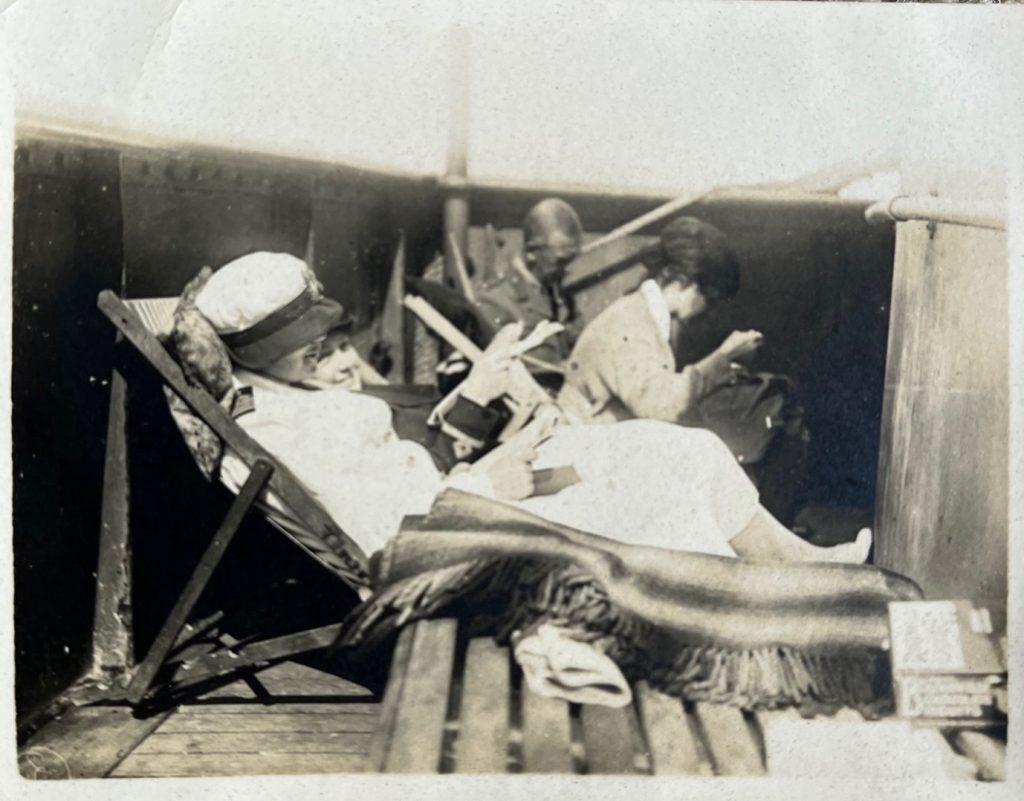
In most of the photographs we have of my aunt she is serious. Dark, beady eyes show her intelligence, there is a patient face, there is rarely a smile. But there is this one image that exudes happiness, even though you can’t see much of her face. She’s on a ship, probably the ship home from Malta, and she’s sitting out in the sun with another woman, who is smiling broadly. My aunt sits back in her deck chair, her naval cap on at a jaunty angle, there’s an air of happy contentment about her manner, the way she holds herself, relaxed and at ease. There is so much in this photograph.
After the war my great aunt became the Lead Almoner (social worker) at the Brompton Hospital, a job she continued until WW2, when she was put in charge of re-housing the bombed-out for the whole of Lewisham – a stressful job, surely. At the end of the war she retired. But her story didn’t end there. In 1946 she was persuaded out of retirement and was asked to go to Berlin for three months, heading up the Child Welfare Team to report on the health and nutrition of women and children. Although the report is very dry, it’s obvious that this must have been a harrowing experience – over-crowded orphanages, an urgent need for shoes, food shortages, increased incidence of disease etc.
In 1951 Con received an MBE for her services to Social Work.
The stories of what may appear to be ordinary women are often more extraordinary than we may, at first, think. Here was a story that had some resonance. I wasn’t able to fill in many of the gaps, but just by looking at her photographs and the tone of the few letters to her that had survived, I felt that some of her life needed to be highlighted.
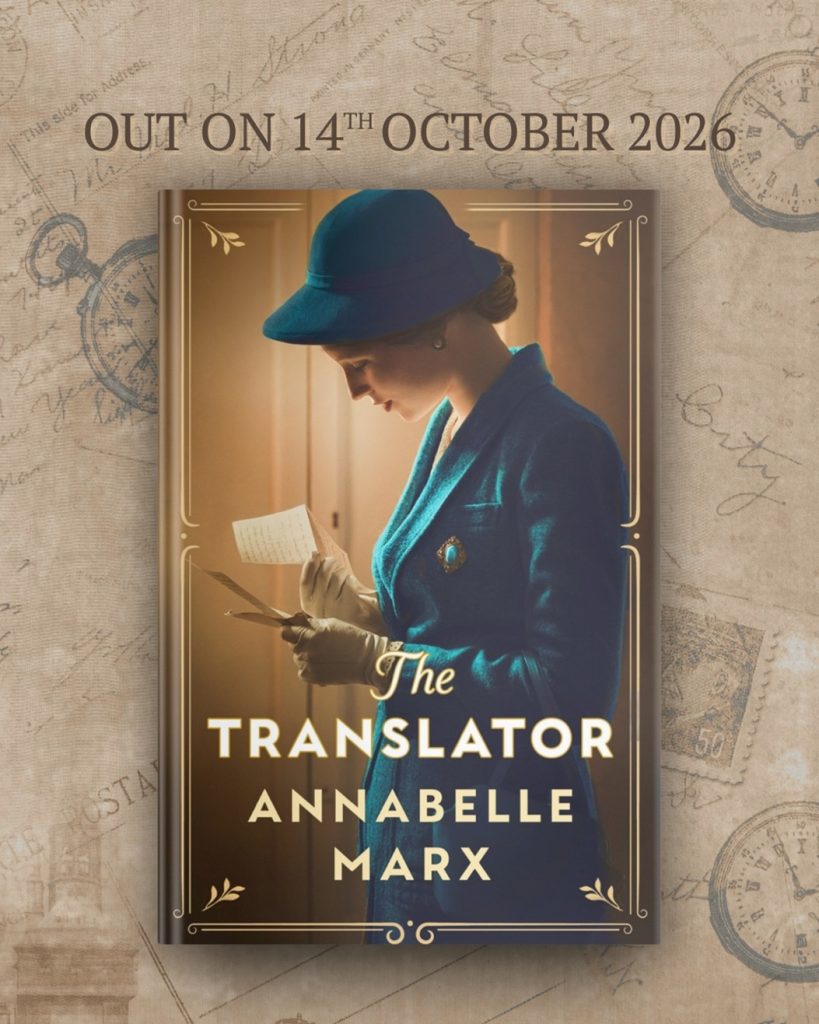
As a result of finding all these snippets of information, I was inspired to write my next novel, The Translator, using a few details of my great aunt’s life to create a story. It’s not about my aunt, but it tells the story of forgotten women, women who made a difference without letting everyone know about it. Finding these stories is important for our future, for our children and for our place in society.
Find out more about Annabelle and her work: annabellemarx.com